 Aaron
Aaron Bluepathways — a portal built as a system, not a page.
A custom Slate portal unifying application status, materials, and segmented workflows into a single real-time interface. Built without a dev team or added budget, in service of clearer applicant journeys and sharper counselor decision-making.
01 · SituationThe work was getting done. The system wasn’t doing the work.
Application data lived in fragments. Status, materials, and workflow stage were spread across screens, queries, and manual reports. Applicants couldn’t see, in one place, where they stood or what they owed next. Counselors answered the same status questions repeatedly — often pulling the same data three different ways to do it.
A team doing skilled work on a platform not yet shaped to support it.
02 · ProblemTwo costs were stacking quietly.
Applicant disengagement. Students dropped off at exactly the moments where momentum mattered most — moments where a clear next action would have moved the needle, but no clear next action was visible.
Counselor time drain. The high-leverage hours of the week went to lookups, status checks, reactive triage. Relationship work — the thing that actually moves yield — got squeezed by administrative work that shouldn’t have required a human at all.
The process didn’t scale. More applicants meant more friction, not more throughput.
03 · ApproachBuild the portal that should have already existed.
Design it as one interface serving two audiences — applicants and counselors — with the same underlying Slate data surfacing two different views. Architect it inside the CRM so it lived where the data lived, with no platform tax and no integration overhead.
Three principles guided the build:
- One source of truth. Status, materials, and workflow stage feed one view. No reconciliation. No second-guessing.
- Segmented by design. Different applicant segments get different surface — same shell, different paths. The system carries the segmentation logic so the staff doesn’t have to.
- Real-time by default. No staging delay. No daily refresh. No “let me check on that and get back to you.”
04 · BuildA custom Slate-built applicant portal, architected to do four things at once.
- Centralize application status, materials tracking, and workflow stage into a single dynamic interface.
- Surface segmented applicant workflows through the same shell — one experience that adapts, not multiple experiences that fragment.
- Give counselors a real-time triage view they can use to prioritize outreach and interpret the funnel without writing a query.
- Give applicants a clear, current picture of their own application — visible status, visible next action.
Built without a dedicated dev team and without an added budget line. The constraint shaped the approach: every decision had to earn its place inside Slate, and every component had to serve both audiences or get cut.
05 · ArchitectureOne shell, two audiences, one source of truth.
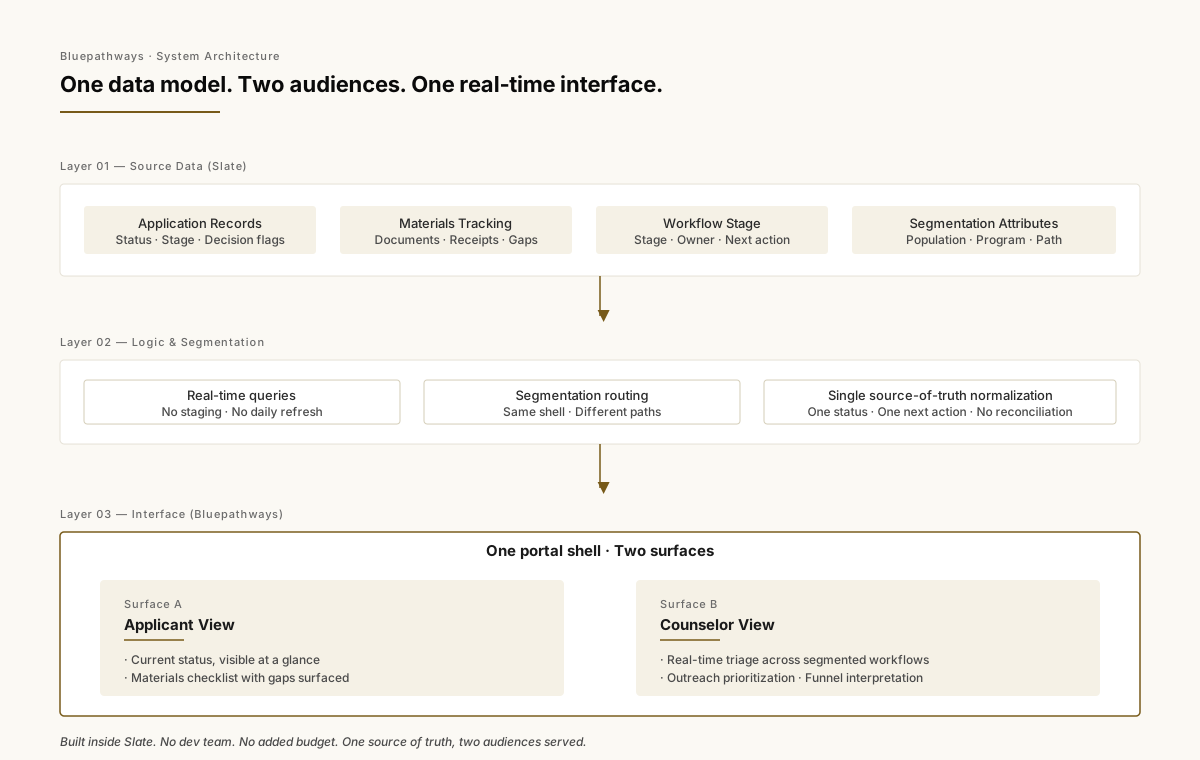
The diagram is honest about what's load-bearing: one data source, one interface layer, two audience-specific projections of the same state.
06 · Render samplesWhat it looks like in production.
Render samples. Sensitive data — applicant names, IDs, internal URLs, and financial fields — has been redacted to protect institutional privacy. UI, structure, and design decisions are shown as built.
07 · OutcomeOperational shift, not cosmetic.
Status moved from inquiry to default. Counselors stopped reconstructing the funnel and started reading it. Applicants stopped guessing where they stood. The admissions team got back the hours that had been quietly absorbed by manual lookup, and pointed them at the conversations that actually move enrollment.
The portal also produced something less visible but more durable: a foundation segmented enrollment ops can scale on, instead of one that breaks under volume. The data structure now matches the operational structure. The interface enforces both.
Bluepathways isn’t a feature shift. It’s an operating shift — from handling every application as an event to handling every application as a state.
08 · TakeawayThe difference between holding data and running operations.
Most enrollment shops wait for the platform to give them a portal. The work here was deciding not to wait. That it shipped without a dev team or added budget is the proof, not the caveat.
The measure of a CRM isn’t what it stores. It’s what it runs.